


4.6/5 real reviews via

Time tracking for projects. Turn hours into profit.

Log your team's hours, track each project's budget, and see what to bill and how much margin is left — without monitoring anyone.

Postage stamp: service excellence, clear vision and profitability

A letter for people who run the service

Every service starts with a promise to the client: deliver good work on time and on budget. Without knowing where the team's time goes, that promise becomes a bet.

Day to day, the questions pile up: what is each person working on? Which project is using more hours? Are there hours that never got billed? Does the planned margin still exist?

The team's time is your main asset, and also one of your biggest costs. When tracking is complicated or feels like surveillance, the team does not adopt it, and you keep deciding in the dark.

Rabbiit connects hours, projects, budget, billing, and profitability in a simple experience for the whole team. Since 2014, we have helped service companies understand the work done and decide with more confidence.

Start seeing your projects. Try Rabbiit.

Dyorg Almeida
Founder of Rabbiit

Estimate the impact on your team

What does time outside your control cost?

Estimated annual impact

$144,000

from unbilled revenue and unproductive time

$76,800in unbilled revenue

$67,200in unproductive time

80 hof billable hours not logged each month

160 hof unproductive hours each month

Estimate based on the values you entered. It does not replace a review of your actual records.

How we calculate this estimate

We use 4 weeks per month and 12 months per year. Unbilled time uses the average selling price per hour. Unproductive time uses the average hourly cost to the company.

(20 people × 1h × 4 weeks × $80 per hour + 20 people × 2h × 4 weeks × $35 per hour) × 12 months

How to use it — it’s really easy

Set it up in minutes and your team gets it on day one. No spreadsheets, no bureaucracy.

1

Create the account, the projects, and the team's cost

Each project's selling rate and each person's cost hit the numbers as soon as time is logged.

1

Create your account

In a few minutes the account is ready for the first project.

2

Add the projects

What the client pays per hour on this project.

3

Set the team's cost

Hourly cost
2

The team logs the hours

Manual entry, timer, browser extension, or automatic logging. The hour lands and the numbers follow.

ManualA direct entry on the timesheet.
TimerStart, pause, and the hour stays on the project.
ExtensionLog time without leaving the browser.
AutomaticHours for people already allocated to the project.
Marketing site$90.00 per hour
Emma
Cost $0.00 Revenue $0.00 Margin $0.00
James
Cost $0.00 Revenue $0.00 Margin $0.00
Client app$140.00 per hour
Olivia
Cost $0.00 Revenue $0.00 Margin $0.00
Noah
Cost $0.00 Revenue $0.00 Margin $0.00
Projects total
Cost $0.00 Revenue $0.00 Margin $0.00
3

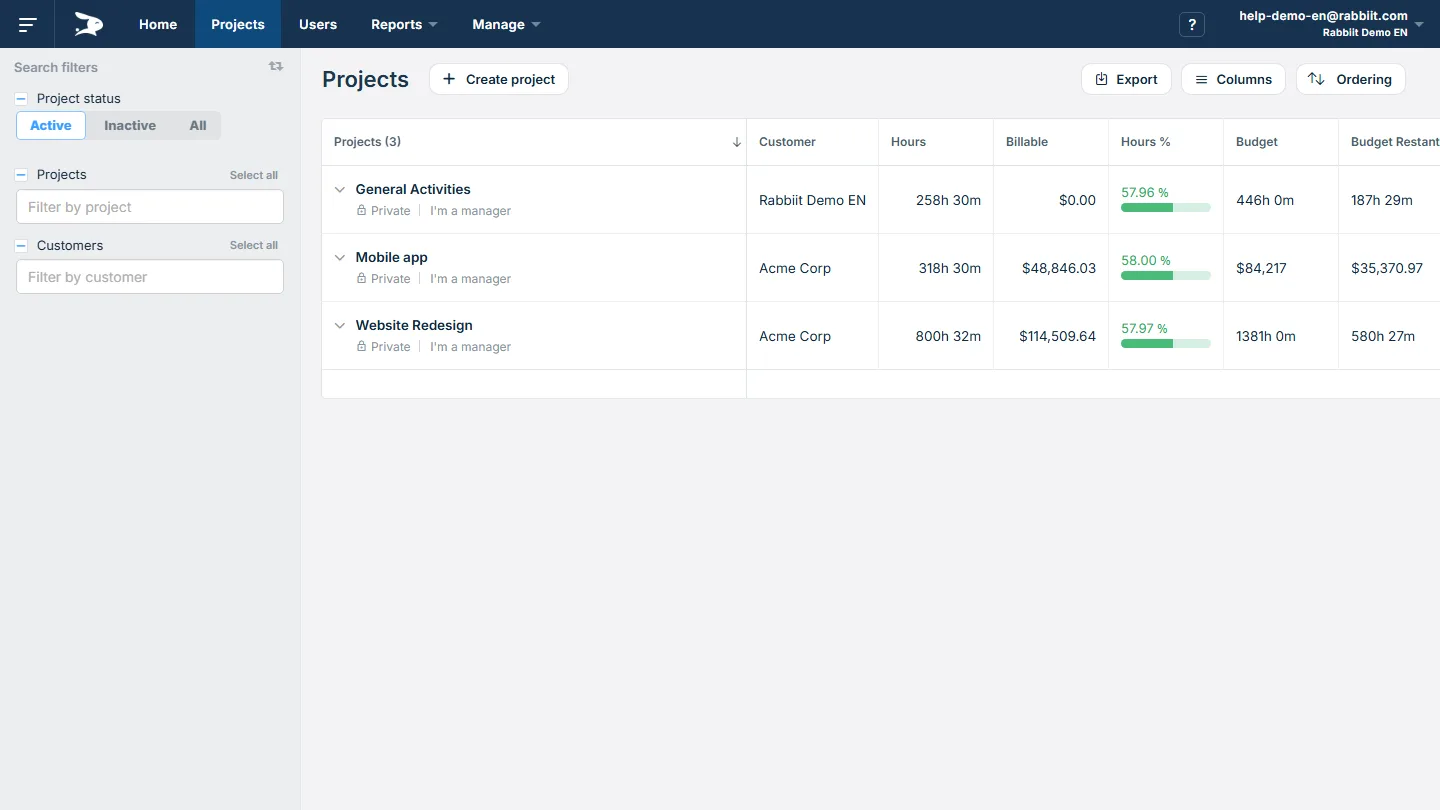
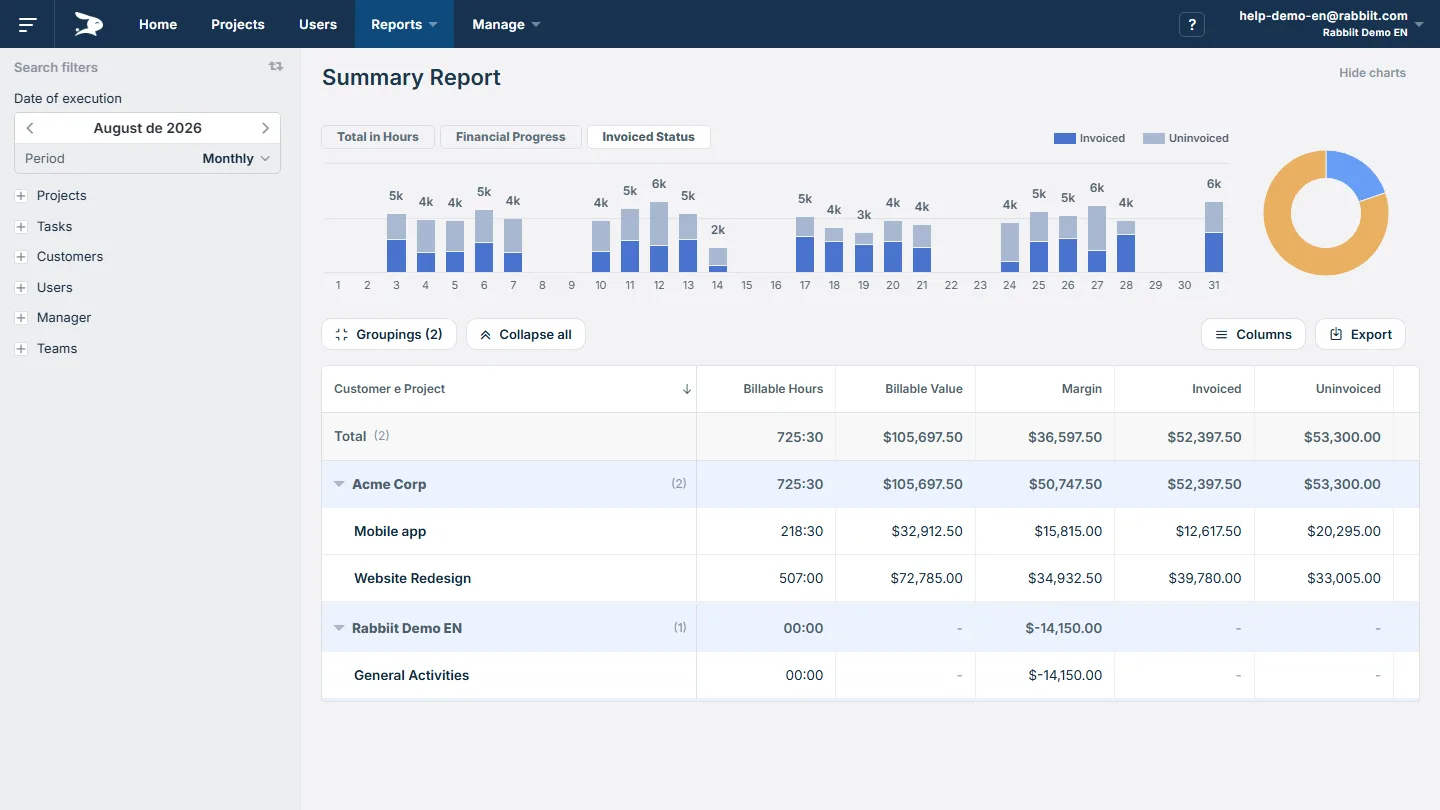
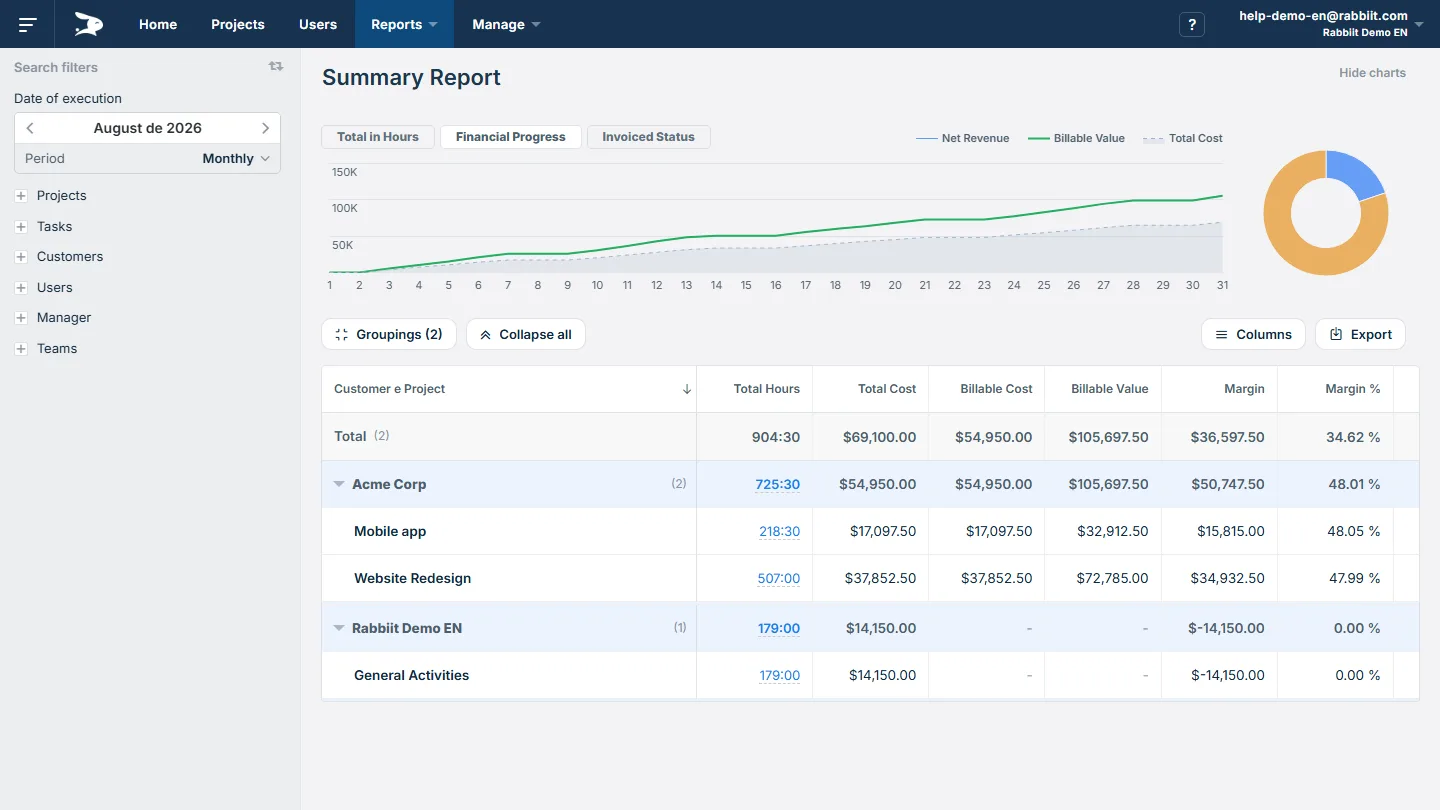
What you start to see

Four results of time tracking. Everything else is one click away.

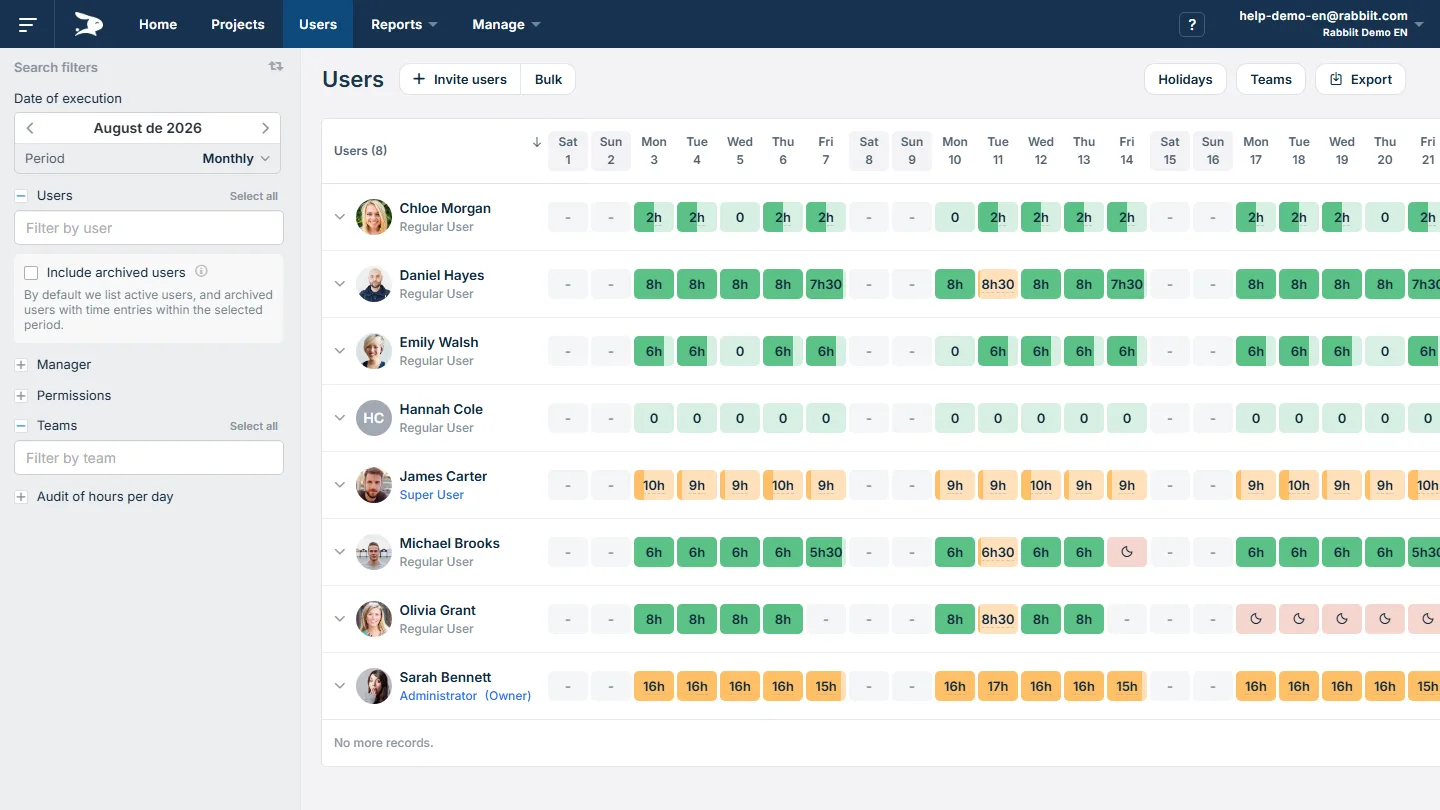
Capacity dashboard for the previous month, one day per column
Learn more

See all features See plans and how to start

What changed for people who use it

Rabbiit was implemented to facilitate centralizing time logging. Before we had individual notes and a lot was lost along the way. We adapted well and now we can measure time for new projects.

– Raíssa A., Architecture Firm Partner

Practical and easy to use! Using Rabbiit improved my perception of how much time I spend on activities so I can plan better, and it's a great tool to present to clients and prove hours and charge fees.

– Larissa C., Law Firm Partner

With many factors affecting time entry, it has become an essential tool for managing expenses and revenue related to hours worked across different clients, projects and tasks. Plus the interface for entering time is user-friendly.

– Guilherme Medeiros, Director of Operations at Prime Control

See all testimonials

When you need it, there are people

A demo, the help center, and email. The same team that builds the product.

Frequently asked questions

What is Rabbiit?

Rabbiit is a time tracking, project management and billing software in one place. It brings together timesheet, budget per project, task tracking and profitability reports, so teams and managers can stop using spreadsheets and have a clear view of time worked and what can be billed.

Why is Rabbiit the best time tracking software?

Rabbiit brings together time tracking, projects, tasks, budget and billing in one tool — no spreadsheets and no friction with the team. You stop paying for multiple tools and reworking data.

We are flexible: the tool grows with your team. You get granular permissions to match your company hierarchy and custom fields on users, projects, clients and time entries to adapt the tool to your processes.

You also get PDF reports with your logo, exports in multiple formats, API for integrations and AWS infrastructure — enterprise-grade features for SMBs.

Since 2014, consultancies, agencies and SMBs have used Rabbiit to manage time, control margin and bill with confidence.

What types of companies and professionals use Rabbiit?

Rabbiit is used by consultancies, architecture and engineering firms, software developers, project managers, marketing and advertising agencies, legal and IT consultancies, accounting firms, designers, freelancers and many other profiles who need to control hours, projects and billing. Most customers are small and medium-sized businesses (SMBs), but we also have teams with over 100 employees using the tool.

How does time tracking work in Rabbiit?

Time can be logged in two ways: with a timer (stopwatch that records time in real time) or manual entry (entering project, task and hours). Rabbiit calculates everything in real time and keeps history by project and client, enabling usage, budget and billing reports without rework.

What is the difference between using Rabbiit and spreadsheets for time tracking?

With Rabbiit, hours stay in one place, linked to projects and clients, and reports are generated automatically — budget, progress and billing. No need to consolidate spreadsheets, fix formulas or waste time on rework. The team logs in seconds and the manager sees in real time what is within budget and what can be billed.

Does Rabbiit generate reports ready for client billing?

Yes. Rabbiit generates custom PDF reports with your logo, professionally formatted — saving time on formatting to send to the client or use as the basis for invoices. You set hourly rates per project or team member and the system calculates the amount to bill. Besides PDF, you can export to CSV and Excel for analysis or integrations. You get full transparency on what was delivered at each stage, without rework.

Can you do estimates and project budgeting in Rabbiit?

Yes. In Rabbiit you set the project budget in two ways: as amount to bill (expected revenue) or as hours estimate (planned hours). The system tracks consumption, progress and variance in real time, so you can avoid overruns before they become losses and keep margin under control.

Can you create task lists and a Kanban board in Rabbiit?

Yes. Rabbiit offers task management with activity lists per project and a Kanban board to visualize flow (To-do, In progress, Done). You can switch between list and Kanban views, assign owners, due dates and estimates, and log time directly on the task — all integrated with time tracking.

How much does it cost? Does Rabbiit have a free plan?

Cost: Paid plan price depends on number of users and period (monthly or annual). You can simulate the amount on our pricing page.

Free plan: Yes. Rabbiit offers a free plan with limited features and a 14-day free trial of paid plans, no credit card required. You can try the full tool and, at the end of the trial, subscribe to a paid plan or stay on the free one.

How do I start using Rabbiit?

Just create your account for free — we don't ask for a credit card for the trial. Then add clients and projects, invite your team and start logging hours (timer or manual). You can try the paid plan free for 14 days and, if you like, stay on the free plan or subscribe to a paid plan when it makes sense.